Automation · 29 September 2026 · 13 min read
Unlock E-commerce Growth: The Advanced Guide to Welcome Series Automation That Converts and Retains
Master e-commerce welcome series automation. Learn multi-channel flows, advanced personalization, and ROI optimization to boost sales, engagement, and customer…
The welcome series is often the first interaction new subscribers have with your e-commerce brand, making it a critical touchpoint for conversion and long-term customer relationships. Beyond basic introductory emails, advanced welcome series automation leverages personalization, multi-channel delivery, and strategic optimization to significantly boost engagement, sales, and customer retention. This guide delves into sophisticated strategies to transform your welcome series into a powerful growth engine for your e-commerce business.
What is a welcome series and why is it crucial for e-commerce growth?
A welcome series is an automated sequence of messages sent to new subscribers or customers, designed to introduce your brand, build rapport, and encourage a first or repeat purchase. It is crucial for e-commerce because it sets the tone for the customer relationship, educates them about your value proposition, and guides them towards conversion during their peak engagement period.The welcome series is typically the first direct communication after a user opts-in, shaping their perception of your brand. This initial impression is vital for establishing trust and interest in what your e-commerce business offers.
It provides an immediate opportunity to engage new leads, answer common questions, and showcase your best products or offers. This proactive engagement can significantly reduce the time it takes for a new subscriber to become a paying customer.
A well-crafted welcome series can significantly increase the likelihood of a first purchase by offering incentives or highlighting unique selling points. This is often the period of highest engagement, making it ideal for a clear call to action.
Beyond the first sale, it lays the groundwork for long-term customer retention by establishing trust and providing value. A strong welcome experience makes customers more likely to return and engage with future marketing efforts.
Finally, it allows you to communicate what subscribers can expect from your brand, including content, promotions, and communication frequency. Setting clear expectations helps to reduce unsubscribe rates and foster a positive ongoing relationship.
How do you build a multi-channel welcome series flow that converts?
Building a high-converting welcome series for e-commerce involves designing a multi-channel flow that strategically delivers value and calls to action across email, SMS, and web push notifications. The optimal cadence typically involves 3-5 messages delivered over 5-10 days, balancing immediate engagement with avoiding overwhelm.Utilize SendCore's multi-channel automation capabilities to reach users where they are most receptive, combining email with SMS and web push notifications for a cohesive experience. This ensures your message cuts through the noise and reaches customers across their preferred communication channels.
Plan a logical sequence of messages, typically starting with a warm welcome, followed by brand story/value, product highlights, social proof, and a clear call to action (e.g., a unique discount code). Each message should build upon the last, guiding the subscriber through a curated journey.
Craft engaging content using SendCore's drag-and-drop editor and AI-assisted content generation to create professional, visually appealing newsletters and messages. Incorporate dynamic products relevant to user interests to make each communication feel personal and timely.
Send the first message immediately after signup, as this is when interest is highest. Subsequent messages can be spaced 1-3 days apart, with the exact timing adjusted based on user behavior and product complexity to maintain engagement without causing fatigue.
Each message should have a single, clear Call to Action (CTA) guiding the subscriber towards the next step, whether it's browsing collections, learning more, or making a purchase. Clarity in CTAs reduces friction and encourages conversion.
Differentiate welcome flows based on how a user signed up (e.g., newsletter signup vs. abandoned cart email opt-in) to tailor the initial message content. This ensures the first touchpoint is highly relevant to their interaction with your brand.
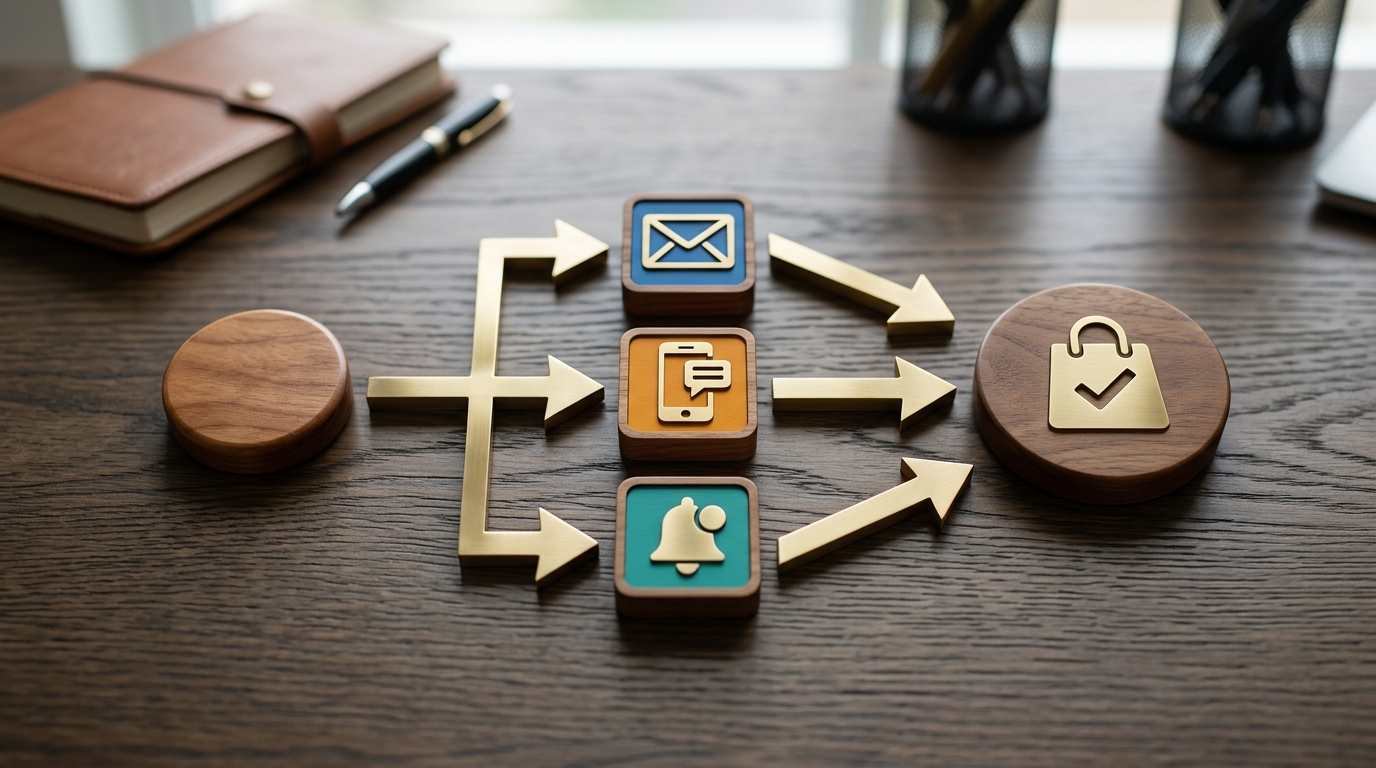
Welcome Email Series Example Structure:
- Email 1 (Immediately): Welcome & Thank You. Introduce your brand, thank them for subscribing, and offer a unique discount code for their first purchase.
- Email 2 (Day 2-3): Brand Story & Value Proposition. Share what makes your brand unique, your mission, or the benefits of your products. Build an emotional connection.
- Email 3 (Day 4-5): Product Showcase & Bestsellers. Highlight popular products or categories relevant to their signup source or browsing history using dynamic product recommendations.
- Email 4 (Day 6-7): Social Proof & Urgency. Include customer testimonials, reviews, or user-generated content. Gently remind them of their unique discount code's expiry or limited stock.
SMS Welcome Messages Best Practices:
- Keep it concise: SMS messages are short and direct. Get straight to the point.
- Offer immediate value: A unique discount code or a link to new arrivals works well.
- Complement email: Use SMS to reinforce key messages or offers from your emails, not to duplicate them entirely.
- Timing is key: Send SMS during business hours to avoid disturbing subscribers.
Integrating Web Push Notifications into the Flow:
- Immediate engagement: Use a web push notification shortly after signup to confirm subscription and provide a quick link to your store.
- Gentle reminders: If a subscriber hasn't opened emails, a push notification can serve as a non-intrusive reminder about a special offer.
- Highlight specific products: Push notifications can direct users to specific new arrivals or personalized product recommendations.
How can advanced automation logic and dynamic content personalize welcome experiences?
Advanced automation logic and dynamic content are key to hyper-personalizing welcome series emails for e-commerce customers, moving beyond generic greetings to deliver highly relevant messages. By leveraging data points like purchase behavior, real-time tagging, and conditional branching, platforms like SendCore can tailor content, offers, and even the sequence of messages to individual preferences.Utilize SendCore's RFM clusters, real-time tagging, and lookalike segments based on purchase behavior and activity to categorize new subscribers instantly. This granular targeting allows for highly specific messaging from the very first interaction.
Implement 'if/then' logic within your automation flow, known as conditional branching, to create tailored journeys. For example, if a subscriber clicks on a specific product category, branch them into a flow showcasing related products; if they don't, send a general brand story or a different offer.
Automatically populate emails with dynamic products based on browsing history, signup source, or stated preferences. SendCore's capabilities allow for seamless integration of these personalized elements, making each email feel uniquely crafted for the recipient.
Instead of generic offers, generate and insert unique discount codes for each subscriber, enhancing perceived value and preventing widespread coupon abuse. This small detail significantly boosts the effectiveness of your incentives.
Use AI tools, like those integrated into SendCore, to help craft personalized subject lines, body copy, and product descriptions that resonate with specific segments. AI-assisted content generation can scale personalization efforts efficiently.
Employ progressive profiling by using early welcome emails to gather more data (e.g., product preferences, frequency of purchase) through subtle questions or click tracking. This data can then be used to refine subsequent messages in the series, continually improving relevance.

Implementing Conditional Logic in Your Welcome Flow:
Conditional logic allows your welcome series to adapt to user behavior in real-time. Set up rules like:
- If subscriber opens Email 1 and clicks on "Men's Apparel," send them Email 2 focused on men's products.
- If subscriber opens Email 1 but doesn't click, send them Email 2 with a broader product range or a stronger incentive.
- If a subscriber makes a purchase at any point in the welcome series, immediately exit them from the remaining welcome emails and transition them to a post-purchase flow.
Real-Time Tagging and Segmentation Strategies:
Automatically tag new subscribers based on their signup source (e.g., "blog subscriber," "checkout opt-in," "social media lead"). Use SendCore's real-time tagging to refine these segments throughout the welcome series based on their interactions:
- Tag users who browse specific categories.
- Tag users who add items to their cart but don't purchase.
- Tag users who click on discount offers.
These tags then inform subsequent personalized messages, ensuring content is always relevant.
Dynamic Product Recommendations in Welcome Emails:
Leverage SendCore's dynamic product capabilities to:
- Display products related to items they viewed before signing up.
- Showcase bestsellers from categories they've shown interest in.
- Suggest complementary products if they've already made a partial purchase or indicated a specific need.
This makes product discovery effortless and highly relevant for the new subscriber.
What are the best practices for optimizing welcome series performance and ROI?
Optimizing your welcome series for maximum ROI involves continuous A/B testing of the entire flow, not just individual emails, and meticulously tracking key performance indicators beyond the initial purchase. This ensures that every touchpoint contributes effectively to sales, retention, and overall customer lifetime value.Go beyond individual email subject lines or content when A/B testing. Test different welcome series lengths, cadences, multi-channel combinations (e.g., email + SMS vs. email only), and conditional branching logic using SendCore's A/B testing features. This holistic approach reveals which strategies truly drive results.
Track key metrics for ROI measurement, including open rates, click-through rates, conversion rates (first purchase, specific product purchases), average order value (AOV) from welcome series recipients, and subscriber churn rate. It's also crucial to measure customer lifetime value (CLTV) for welcome series cohorts to understand long-term impact.
Evaluate the long-term impact of your welcome series on repeat purchases, engagement with subsequent campaigns, and overall customer retention, not just immediate sales. A successful welcome series should cultivate loyal customers, not just one-time buyers.
Use insights from A/B tests and performance metrics to continuously refine your welcome series. Small, data-driven adjustments to content, timing, or offers can yield significant improvements over time, demonstrating the power of iterative optimization.
While specific numbers vary, aim for welcome series open rates significantly higher than regular campaigns (often 50-70%) and conversion rates that contribute meaningfully to your overall sales goals. Benchmarking against industry standards provides a valuable context for your performance.
Incorporate subtle ways to gather feedback from new subscribers, such as preference centers or simple 'Was this helpful?' prompts, to inform future optimizations. Direct feedback can provide invaluable qualitative data to complement your quantitative metrics.
Measuring ROI Beyond the First Purchase:
To truly understand the ROI of your welcome series, look at metrics that extend beyond the initial conversion:
- Repeat Purchase Rate: How many welcome series customers make a second, third, or fourth purchase?
- Customer Lifetime Value (CLTV): Compare the CLTV of customers who went through your welcome series versus those who didn't (if applicable).
- Engagement with Subsequent Campaigns: Are welcome series recipients more likely to open and click on your regular newsletters and promotional emails?
- Referral Rates: Do welcome series customers refer new customers more frequently?
Advanced A/B Testing Strategies for Welcome Flows:
- Flow Length & Cadence: Test a 3-email series over 5 days against a 5-email series over 10 days.
- Offer Type: Compare a percentage discount vs. a fixed amount discount, or free shipping.
- Multi-Channel Mix: A/B test a flow with email only against a flow with email + SMS, or email + web push.
- Content Focus: Test a series focused on brand story versus one focused on product benefits.
- Conditional Logic Paths: Experiment with different branching rules to see which leads to higher engagement or conversions.

Benchmarking and Goal Setting for Welcome Series Success:
Set specific, measurable goals for your welcome series. While benchmarks vary by industry, consider these as starting points:
- Open Rate: 50-70% (significantly higher than average campaign rates).
- Click-Through Rate (CTR): 10-20%.
- Conversion Rate: Aim for a conversion rate that contributes significantly to your overall new customer acquisition.
- Unsubscribe Rate: Keep it below 1-2%.
- Attributed Revenue: Track the direct revenue generated by the welcome series.
How does welcome series automation integrate with your broader e-commerce strategy?
Welcome series automation is not an isolated effort but a foundational component that must integrate seamlessly with your broader e-commerce marketing strategy, unifying sales channels and enhancing the entire customer journey. This integration ensures a consistent brand experience and maximizes the impact of every customer touchpoint, from initial signup to post-purchase engagement.Leverage SendCore's ability to unify email, SMS, and web push notifications, ensuring your welcome series is part of a cohesive multi-channel strategy across all customer interactions. This unified approach prevents disjointed messaging and enhances brand recall.
Ensure your welcome series platform, like SendCore, integrates natively with e-commerce platforms such as Shopify and WooCommerce, allowing for real-time data synchronization for accurate segmentation and personalization. This direct connection is crucial for up-to-date customer profiles.
Design your welcome series to naturally lead into other critical automation flows, such as abandoned cart recovery sequences, browse abandonment flows, or post-purchase upsell campaigns. This creates a continuous and intelligent customer journey.
Ensure data captured or inferred during the welcome series (e.g., product interests, engagement levels) is passed to your CRM or customer support systems for a holistic customer view. This enables more informed interactions across all departments.
Coordinate welcome series content with your broader content marketing calendar, ensuring consistency in brand messaging and promotional efforts. A harmonious approach reinforces your brand identity and avoids conflicting messages.
Use the initial engagement data from the welcome series to refine RFM clusters, ensuring that subsequent marketing efforts are also highly targeted and relevant to the customer's value and behavior. This continuous data feedback loop drives long-term customer value.
Connecting Welcome Series to Abandoned Cart Flows:
A seamless transition from welcome to abandoned cart flows is crucial. If a subscriber adds items to their cart but doesn't complete the purchase during or after the welcome series, SendCore can:
- Automatically exit them from the welcome series.
- Enroll them into a dedicated abandoned cart recovery sequence.
- Tailor the abandoned cart message to acknowledge their previous engagement with the welcome series, perhaps even reminding them of their unique welcome discount code.
Integrating with Post-Purchase Upsell Strategies:
Once a welcome series subscriber makes their first purchase, the journey shouldn't end. Integrate your welcome series with post-purchase automation:
- Immediately send a thank-you email and order confirmation.
- Enroll them into a post-purchase upsell/cross-sell flow after a few days, recommending complementary products based on their purchase history.
- Invite them to leave a review or share their experience, further building loyalty and social proof.
Ensuring Brand Consistency Across All Channels:
Maintain a consistent brand voice, visual identity, and messaging across all channels within your welcome series and beyond. SendCore's drag-and-drop editor facilitates this by allowing you to easily apply brand guidelines to emails, SMS, and web push notifications. This consistency builds trust and reinforces your brand's presence in the customer's mind.